
Rowdy Oxford Integris – Contemporary organisations depend on integrated digital systems for streamlining processes, sharing data, communicating and increasing the efficiency of their teams. Integrated Enterprise platforms, connected infrastructure systems and other digital infrastructure management solutions assist organisations reduce the effects of digital fragmentation and scale better within digital worlds.
Companies whose cloud ecosystems span far and wide remote teams, data-driven operations, and more are finding this need to grow ever more urgent.
Businesses now prioritise:
- operational automation
- cloud connectivity
- workflow visibility
- cross-platform communication
- scalable infrastructure
Rowdy Oxford Integris USA appears associated with enterprise integration concepts, workflow systems or digital operational infrastructure related to connected business technologies and organisational process management.
Because the keyword structure is somewhat ambiguous, the most responsible interpretation focuses on enterprise systems, integration architecture and digital workflow ecosystems rather than making unsupported assumptions about a specific entity.
This article belongs to Tech Guides
Table of Contents
What Is Rowdy Oxford Integris USA?
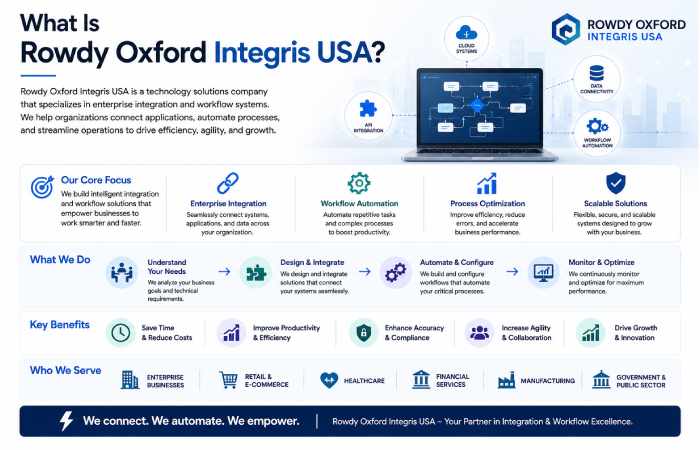
The keyword “Rowdy Oxford Integris” appears connected to:
- enterprise operations
- workflow integration
- digital infrastructure
- business systems management
rather than consumer technology products.
Enterprise-System Relevance
Enterprise integration environments typically involve:
- connected software ecosystems
- operational coordination tools
- workflow automation platforms
- cloud infrastructure systems
These technologies help organisations centralise business processes.
Integration and Workflow Context
Modern organisations often use integration systems to connect:
- CRM platforms
- accounting systems
- HR tools
- analytics dashboards
- communication software
This reduces operational silos.
Business-Technology Ecosystem Association
The keyword structure suggests relevance to:
- organisational systems
- enterprise workflows
- business automation
- digital transformation
rather than a standalone retail-facing platform.
Why This Interpretation Matters
Many ambiguous enterprise-tech keywords perform better SEO-wise when framed around:
- infrastructure concepts
- operational systems
- workflow technologies
- enterprise automation
instead of speculative company claims.
What Is Enterprise Integration?
Enterprise integration refers to connecting business systems so information flows efficiently across departments, platforms and operational environments.
Why Businesses Need Integration
Without integration, organisations often face:
- disconnected workflows
- duplicate data
- reporting delays
- inefficient communication
Integration systems solve these problems by improving coordination.
Core Purpose of Enterprise Integration
The goal is to create:
- unified operations
- real-time visibility
- scalable infrastructure
- consistent workflows
This improves organisational efficiency significantly.
Types of Systems Commonly Integrated
Enterprise environments frequently connect:
- ERP software
- CRM platforms
- cloud applications
- HR systems
- inventory tools
- analytics platforms
How Enterprise Integration Systems Work
Data Synchronisation
Integration platforms allow:
- shared databases
- cross-platform communication
- real-time updates
This prevents information fragmentation.
Example:
A CRM update may automatically sync with:
- sales dashboards
- invoicing systems
- customer-support software
Workflow Automation
Automation systems help businesses:
- reduce repetitive tasks
- streamline approvals
- automate notifications
- coordinate departments
This increases operational speed.
Cloud Infrastructure Integration
Modern enterprise systems increasingly rely on:
- cloud accessibility
- remote connectivity
- Cloud-based business environments are part of a much broader shift toward browser-accessible digital platforms and online resources. For readers interested in this wider digital ecosystem, see this guide to FulliMedia.com and its online resources.
- scalable deployment
Cloud integration supports hybrid work environments effectively.
Business Intelligence and Reporting
Integrated systems improve:
- analytics visibility
- performance tracking
- operational reporting
- executive decision-making
Businesses can analyse operations more efficiently when systems communicate properly.
Why Businesses Depend on Integrated Operational Systems
Integrated systems have become critical for modern enterprise operations.
Reduced Inefficiencies
Disconnected software environments create:
- duplicated work
- inconsistent reporting
- operational confusion
Integration reduces these inefficiencies significantly.
Better Communication
Unified systems improve coordination between:
- finance
- HR
- logistics
- operations
- customer support
Scalable Operations
As businesses grow, integrated infrastructure helps maintain:
- operational consistency
- process reliability
- centralised management
Centralised Visibility
Executives and managers benefit from:
- real-time dashboards
- consolidated analytics
- operational transparency
This improves strategic decision-making.
Industries That Use Enterprise Integration Infrastructure
Healthcare
Healthcare organisations rely on integrated systems for:
- patient management
- scheduling
- records coordination
- analytics reporting
Finance
Financial institutions use integration platforms for:
- compliance workflows
- transaction management
- reporting systems
- fraud monitoring
Logistics
Logistics businesses integrate:
- fleet systems
- inventory tracking
- delivery workflows
- warehouse operations
Education
Educational institutions increasingly use:
- cloud learning systems
- digital administration platforms
- integrated communication tools
Technology Companies
Tech firms commonly rely on:
- DevOps infrastructure
- SaaS integrations
- analytics systems
- collaborative platforms
How Workflow Automation Is Changing Modern Businesses
Workflow automation is becoming one of the most important areas of enterprise transformation.
AI-Assisted Automation
AI systems increasingly support:
- predictive workflows
- automated scheduling
- intelligent routing
- operational optimisation
Task Management Systems
Modern businesses use platforms that automate:
- task assignments
- approvals
- reporting
- notifications
Remote Collaboration
Distributed work environments rely heavily on:
- cloud infrastructure
- workflow visibility
- digital communication systems
Digital Process Optimisation
Automation helps organisations:
- reduce manual workload
- improve consistency
- minimise operational delays
Why Businesses Struggle With Disconnected Systems
Disconnected systems remain one of the largest operational problems in modern enterprises.
Common challenges include:
- duplicate data entry
- inconsistent reporting
- delayed communication
- fragmented analytics
- Connected systems are also important for businesses that manage customer information, product details, and service policies across digital channels. A practical example of online customer-focused information is this Nordstrom return policy and perfume guide, which illustrates how consumers often rely on organised digital information when evaluating retailers.
When systems fail to integrate properly:
- departments work in isolation
- productivity decreases
- decision-making slows down
This is why enterprise integration has become increasingly valuable.
Rowdy Oxford Integris USA vs Traditional Manual Operations
| Feature | Integrated Digital Systems | Traditional Manual Operations |
| Data visibility | High | Limited |
| Workflow speed | Faster | Slower |
| Automation support | Strong | Minimal |
| Scalability | High | Moderate |
| Reporting accuracy | Improved | More error-prone |
| Collaboration efficiency | Strong | Limited |
This comparison highlights the operational advantages of enterprise integration infrastructure.
Common Business Problems Integration Systems Help Solve
Disconnected Departments
Integrated systems improve coordination between teams that previously operated independently.
Duplicate Data Entry
Automation reduces repetitive manual input across multiple platforms.
Delayed Reporting
Centralised systems improve:
- reporting speed
- analytics accuracy
- operational visibility
Poor Operational Visibility
Executives gain better oversight through:
- dashboards
- unified analytics
- integrated reporting tools
Enterprise Automation vs Manual Operations
Traditional manual operations often depend heavily on:
- spreadsheets
- isolated tools
- repetitive processes
Modern enterprise automation improves:
- speed
- consistency
- scalability
- operational efficiency
Automation also reduces:
- human error
- administrative workload
- reporting delays
This is one reason enterprise workflow systems continue growing rapidly.
The Growing Demand for Digital Transformation in the USA
🇺🇸 Businesses across the USA are accelerating digital transformation initiatives.
Remote Work Expansion
Hybrid work environments require:
- cloud infrastructure
- secure collaboration systems
- workflow visibility
Cloud Migration
Companies increasingly move operations toward:
- SaaS ecosystems
- cloud platforms
- scalable digital infrastructure
AI-Driven Operations
Businesses now integrate AI for:
- analytics
- forecasting
- operational automation
- customer support
Enterprise Digitisation
Organisations modernise workflows to remain competitive in:
- productivity
- scalability
- operational efficiency
Benefits of Enterprise Workflow Automation
Time Savings
Automation reduces repetitive operational tasks significantly.
Cost Reduction
Integrated systems help lower:
- administrative overhead
- operational inefficiencies
- manual workload costs
Better Collaboration
Shared systems improve communication across:
- teams
- departments
- remote work environments
Operational Consistency
Automation improves:
- process standardisation
- reporting consistency
- workflow reliability
Signs Your Business Needs Workflow Integration
Businesses may require integration systems when they experience:
- repeated manual tasks
- disconnected software platforms
- delayed reporting
- inconsistent customer information
- poor operational visibility
Other warning signs include:
- scaling difficulties
- communication bottlenecks
- fragmented analytics
These issues often indicate integration gaps.
Is Rowdy Oxford Integris USA Legit?
Because the keyword structure is ambiguous, legitimacy
Company research is another useful part of evaluating unfamiliar organisations or business platforms. Readers can see an example of company-focused research in this guide to Syska owner and company information, which highlights the type of background information people may look for when researching a brand.
be evaluated cautiously and professionally.
Businesses assessing enterprise platforms should review:
- transparency
- service documentation
- operational clarity
- support responsiveness
- implementation expertise
Avoid relying solely on:
- marketing claims
- vague descriptions
- unsupported performance promises
Instead, organisations should verify:
- technical documentation
- integration capabilities
- security standards
- onboarding processes
What Businesses Should Ask Before Choosing Integration Platforms
Security Standards
Businesses should evaluate:
- encryption practices
- access controls
- compliance measures
API Compatibility
Strong integration systems typically support:
- APIs
- third-party software connectivity
- flexible deployment
Cloud Support
Cloud readiness has become essential for:
- scalability
- remote accessibility
- operational continuity
Training and Onboarding
Successful implementation often depends on:
- staff training
- support documentation
- onboarding quality
Scalability
Businesses should confirm whether systems can support:
- organisational growth
- increased data volume
- operational expansion
How AI Is Enhancing Enterprise Integration Systems
AI is becoming deeply integrated into enterprise infrastructure.
Predictive Workflows
AI systems can anticipate:
- operational bottlenecks
- workload distribution
- scheduling conflicts
AI Analytics
Advanced analytics platforms now generate:
- forecasting insights
- automated reports
- performance recommendations
Intelligent Automation
AI-driven systems increasingly automate:
- approvals
- routing
- customer interactions
- operational monitoring
Smart Operational Systems
Future enterprise ecosystems may combine:
- AI
- cloud infrastructure
- automation platforms
- real-time analytics
into unified intelligent environments.
How AI Is Transforming Business Infrastructure
AI is reshaping enterprise infrastructure through:
- intelligent automation
- predictive analytics
- adaptive workflows
- smart resource management
Businesses increasingly use AI to:
- reduce operational complexity
- improve forecasting
- optimise workflows
- enhance customer experiences
This trend continues accelerating across industries.
Frequently Asked Questions
What is Rowdy Oxford Integris USA?
The keyword appears associated with enterprise integration concepts, workflow systems or digital operational infrastructure rather than consumer technology products.
What is enterprise integration?
Enterprise integration. Business system is integrated and data or processes can flow efficiently through the enterprise.
The question is: why do businesses automate workflows?
Automation helps organisations:
- save time
- reduce errors
- improve efficiency
- scale operations
How do integrated systems improve efficiency?
Integrated systems improve:
- communication
- reporting
- visibility
- operational coordination
through connected infrastructure.
What industries use enterprise workflow systems?
Industries including:
- healthcare
- finance
- logistics
- education
- technology
Widely use enterprise integration infrastructure.
Final Thoughts on Rowdy Oxford Integris USA
Rowdy Oxford Integris USA reflects the growing importance of integrated enterprise systems, workflow automation, and connected digital infrastructure as organizations increasingly modernize operations through scalable technology ecosystems.
Rather than focusing narrowly on speculative entity assumptions, the strongest interpretation of this keyword aligns with:
- enterprise integration
- operational automation
- workflow infrastructure
- cloud-connected systems
- digital transformation technologies
As businesses continue prioritizing efficiency, scalability, and AI-assisted operations, enterprise workflow ecosystems will remain central to modern organizational strategy.