


If you’ve ever launched a product, planned a campaign, or tried to understand what customers actually want, you’ve probably heard of a market survey.
This article belongs to content marketing
Simply put, a market survey is one of the most practical tools businesses use to reduce guesswork. Instead of assuming what people want, you ask them directly — and use their responses to guide decisions.
In this guide, we’ll cover:
-
What a market survey really is
-
The main objectives of a market survey
-
Types of market surveys
-
Benefits and limitations
-
Common mistakes people make
-
Practical tips and real examples
All explained in clear, human language.
Table of Contents
What Is a Market Survey? (Simple Definition)
A market survey is a research method used to collect information directly from a target audience about their needs, preferences, behavior, and opinions.
Businesses use market surveys to answer questions like:
-
What problems do customers face?
-
How satisfied are they with current products?
-
What features or improvements do they want?
-
How much are they willing to pay?
Instead of relying on assumptions, surveys provide real feedback from real people.
Why Market Surveys Matter Today
Markets are more competitive than ever. Customer expectations change quickly, and a single misstep can cost time and money.
Market surveys help by:
-
Reducing business risk
-
Improving product-market fit
-
Supporting smarter marketing strategies
-
Helping companies stay customer-focused
Whether you’re a startup, a large company, or even a student working on a project, market surveys give direction.
Objectives of a Market Survey
The main objectives of a market survey are to understand the market and make informed decisions.
1. Understand Customer Needs and Preferences
One of the primary goals of a market survey is to learn what customers actually want.
This includes:
-
Their problems and pain points
-
Preferred features or services
-
Buying habits and expectations
When businesses understand their customers clearly, they can design better solutions rather than guess.
2. Measure Customer Satisfaction
Market surveys help assess how happy customers are with:
-
Products or services
-
Pricing
-
Customer support
-
Overall experience
Customer satisfaction surveys often reveal issues that aren’t visible through sales data alone.
3. Identify Market Demand and Trends
Surveys can uncover:
-
Emerging trends
-
Shifts in consumer behavior
-
Changes in demand
This information helps businesses stay ahead of competitors rather than reacting too late.
4. Support Product Development and Improvement
Before launching a new product — or improving an existing one — companies use surveys to test ideas.
For example:
-
Feature preference surveys
-
Prototype feedback surveys
-
Pricing sensitivity surveys
This minimizes the risk of launching something customers don’t want.
5. Improve Marketing and Communication
Market surveys help marketers understand:
-
Which messages resonate
-
Which channels do customers prefer
-
What influences purchasing decisions
As a result, campaigns become more targeted and effective.
Once you understand which messages resonate with your audience, you can use those insights to develop stronger campaigns and creative marketing strategies and frameworks that connect with customers more effectively.
Types of Market Surveys
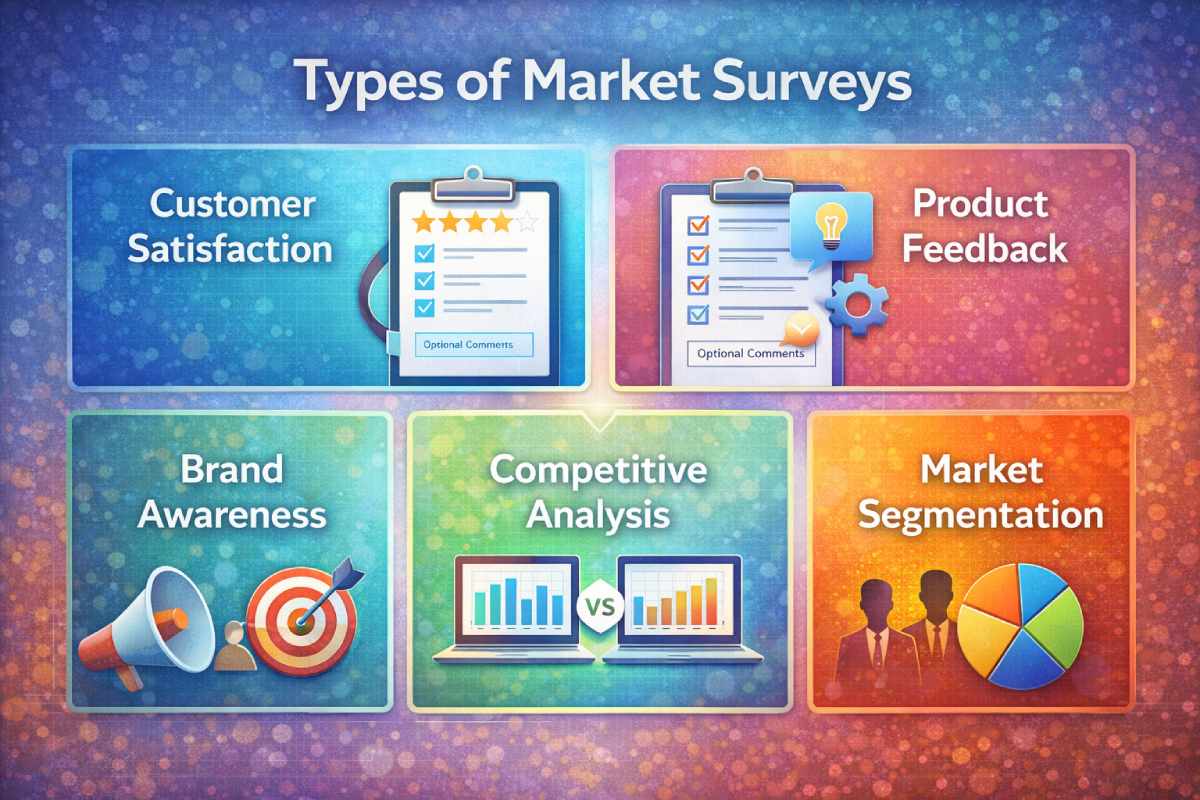
Different goals require different survey approaches.
1. Customer Satisfaction Surveys
These surveys measure customer satisfaction after a purchase or interaction.
They usually include:
-
Rating scales
-
Short feedback questions
-
Net Promoter Score (NPS)
2. Product Feedback Surveys
Used to gather opinions on:
-
New features
-
Product usability
-
Design and functionality
These surveys are common during beta testing or product updates.
3. Brand Awareness Surveys
These surveys help businesses understand:
-
How well their brand is recognized
-
Brand perception
-
Trust and credibility
They’re especially useful for marketing and branding strategies.
When measuring brand perception, it’s also important to understand that third-party reviews and promotional coverage are not always definitive. This guide on why PR reviews aren’t a jury provides additional context when evaluating external feedback.
4. Market Segmentation Surveys
Segmentation surveys group customers based on:
-
Age, location, income
-
Interests and behavior
-
Buying patterns
This helps businesses target the right audience more effectively.
5. Competitive Analysis Surveys
These surveys compare your product or service with competitors by asking customers directly what they prefer — and why.
Benefits of Conducting a Market Survey
Market surveys offer several clear advantages:
✔ Better decision-making
✔ Reduced business risk
✔ Stronger customer relationships
✔ Improved product and service quality
✔ More effective marketing strategies
In short, surveys help businesses move from assumptions to insights.
Limitations of Market Surveys
While market surveys are powerful, they’re not perfect.
Some limitations include:
-
Biased responses
-
Low response rates
-
Poorly designed questions
-
Misinterpretation of data
This is why survey design and analysis matter as much as data collection.
Common Mistakes People Make in Market Surveys
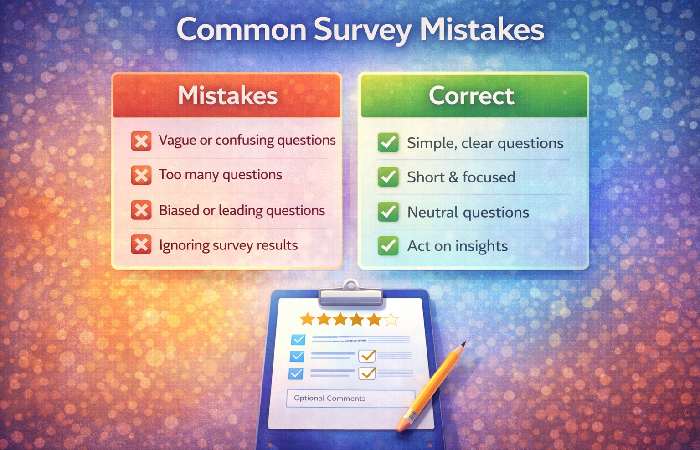
Many surveys fail not because surveys don’t work, but because they’re done incorrectly.
❌ Asking vague or confusing questions
Respondents don’t know how to answer clearly.
❌ Asking too many questions
Long surveys lead to drop-offs and poor-quality responses.
❌ Using biased or leading questions
This skews results and reduces reliability.
❌ Ignoring the results
Collecting data without acting on it defeats the purpose.
Practical Tips for Running an Effective Market Survey
Here are some proven tips to improve survey results:
✔ Keep surveys short and focused
✔ Use simple, clear language
✔ Avoid leading questions
✔ Test the survey before sending it
✔ Analyze results objectively
✔ Share insights with decision-makers
From experience, a short, well-designed survey often performs better than a long, complex one.
Real-World Examples of Market Surveys
Example 1: Product Improvement
A mobile app surveys users about feature usage and removes rarely used features to improve performance.
Example 2: Pricing Strategy
A company tests different price points through surveys before finalizing product pricing.
Example 3: Customer Experience
An e-commerce brand surveys customers after delivery to identify issues in packaging or shipping.
or businesses that need help turning customer research into practical growth campaigns, exploring how a digital marketing agency approaches growth strategy can provide additional ideas.
Myths vs. Facts About Market Surveys
| Myth | Fact |
|---|---|
| Surveys always reflect the full market | They reflect the surveyed audience |
| More questions mean better insights | Focused questions work better |
| Surveys are expensive | Many tools offer low-cost or free options |
| Surveys guarantee success | They guide decisions, not guarantee outcomes |
When Should You Conduct a Market Survey?
Market surveys are useful when:
-
Launching a new product
-
Entering a new market
-
Improving existing offerings
-
Measuring customer satisfaction
-
Planning marketing campaigns
They’re not a one-time activity — successful businesses survey continuously.
FAQs (Snippet-Ready)
Q: What is the main objective of a market survey?
A: The main objective is to understand customer needs and market conditions to support better business decisions.
Q: Are market surveys only for large businesses?
A: No, startups, small businesses, and students can all benefit from market surveys.
Q: How long should a market survey be?
A: Ideally short — usually 5–10 minutes — to maintain response quality.
Q: Can online surveys replace face-to-face surveys?
A: Online surveys are efficient, but both methods have value depending on goals.
Final Conclusion
A market survey is one of the most effective ways to understand customers, reduce uncertainty, and make informed decisions. By clearly defining objectives, choosing the right survey type, and avoiding common mistakes, businesses can turn customer feedback into meaningful action. When done correctly, market surveys don’t just collect data — they guide smarter strategies and long-term success.