
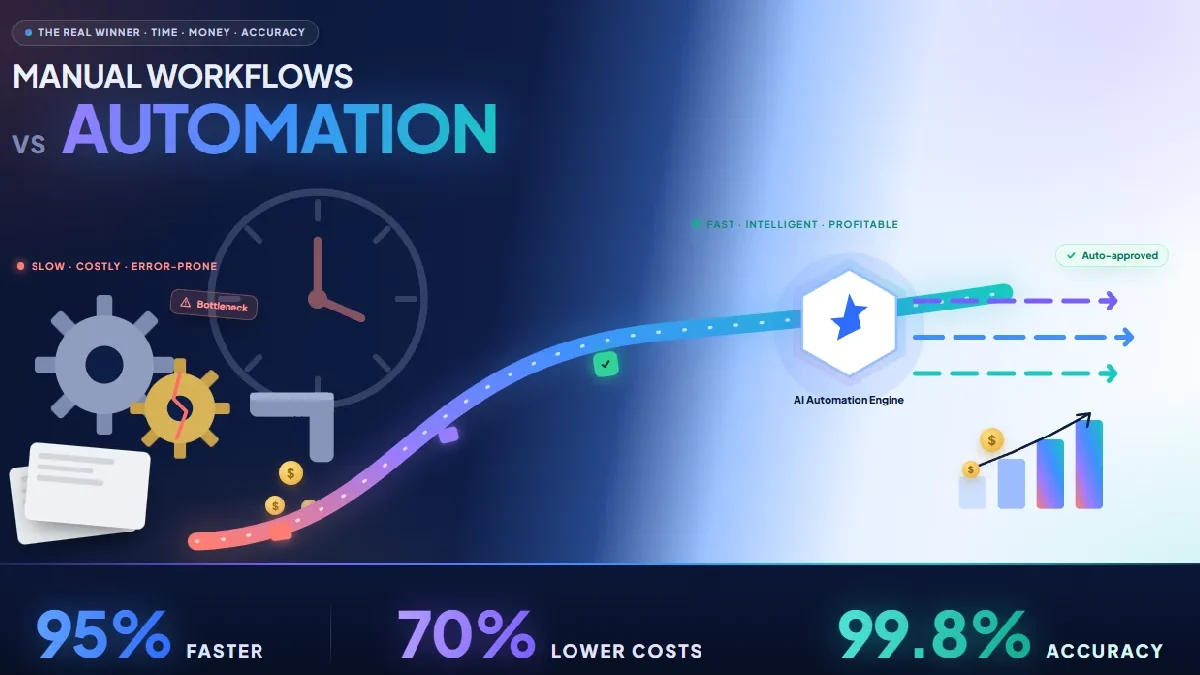
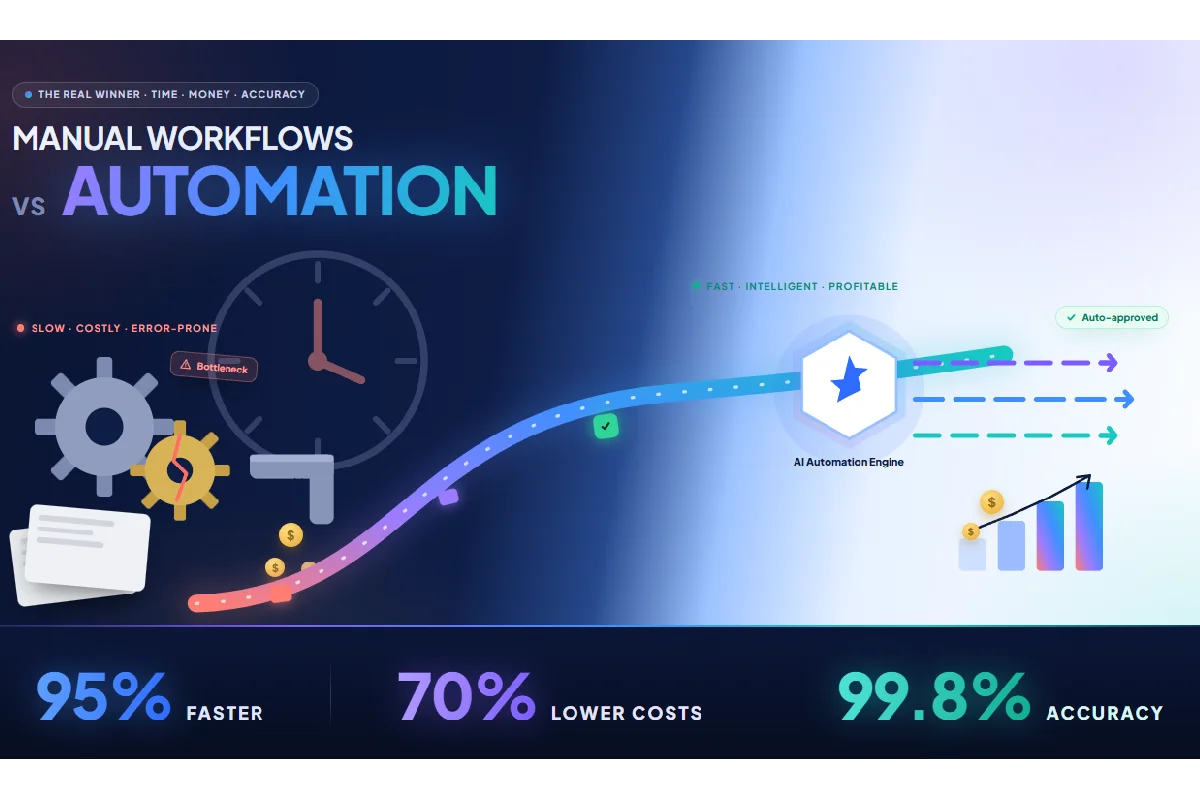
Manual Workflows vs Automation – A few months back I was speaking with the senior manager at that time he was stressed. Even simple approval does not get completed fast. Everything in the company runs normally. Using Emails, spreadsheets shared folders they manage daily operations
If you see from outside everything was organized, but you see in depth you will see the real problem.
Even one purchase request still pending in manager’s inbox, happing delay in employee onboard task because one department assumes another one is already completed many managers come to office in the morning, they did not do real work because they spend time on checking request status these all is not big disaster.
But problem is it happens every day, that is the main problem of manual workflows, it’s not collapse business in a single day, instead of that it creates small delays, those delays accumulate big productivity loss
This article belongs to Tech Guides
Table of Contents
Initially Manual Work Process Works Well
Manual workflow is not bad naturally; actually, almost all companies start with a manual process. If a company has only 5 employees, it doesn’t need a complicated system: they send a message, they get a reply, and the job is finished. The problem happens only when those five employees become more. That’s when confusion begins.
Not every process needs to be complicated from the beginning, much like the way technology trends can develop gradually, from simple systems to more organized digital experiences, as seen in the growing interest in NES retro collecting
All of a sudden, there are more requests being sent, more approvals needed, more follow-ups happening and ultimately more confusion creeping in, the steps we follow remain the same, but the sheer amount of everything is what really changes and that’s where the difference lies
Let’s See What Automation Does Now
Automation does not replace employees. Only remove repeated tasks. Even now also dession maker is manager only, but the system handles all the repetitive tasks—things like reminders, status tracking, notifications, and record updates. Because of that, employees don’t waste their time on repetitive work. This allows them to spend their energy on more valuable work, leading to better results overall
Automation is now used across many different digital activities, including financial platforms and services such as forex copy trading, where technology can help handle repetitive processes and follow predefined actions.
This might seem obvious, but practically, this is the biggest advantage of automation. When companies implement automation, the first thing they notice isn’t just time saving. Even before that, they see the work moving more smoothly, with fewer interruptions and less friction
Before, when you submitted something, you had to follow up. Who has it, is it approved, is it pending? Now, the workflow moves on its own. Team members spend less time updating their status, and even managers don’t have to give unnecessary updates. If a manager is handling 20 requests every day and tries to keep track of each one by hand, they’ll have less time to focus on real strategic work. But with automation, the system handles all that repeated tracking. As a result, the manager can give their attention to important decisions.
Not Just Time, But Money Is Saved Too
Many business owners think about automation, the first question they usually ask is, “How much does automation software cost?” But that’s not the right question. The real question is, “How much is lost by continuing manual processes?” That difference matters. For example, if one employee spends 30 minutes a day on approval of follow-ups and updating spreadsheets, over a month that adds up to many hours. Now, if 20 employees in the company are doing that same work, imagine how big the hidden cost becomes.
This is something many organizations don’t calculate, so they just accept inefficiency as normal. Automation doesn’t immediately reduce employees, but it helps the existing resources get more work done. That’s the real return on investment.
Let’s Talk About Accuracy
Humans are not perfect. Someone might make a typo, someone might enter wrong data, someone might miss an attachment, these are normal. But when a business process is fully manual, these mistakes happen more.
A small error can sometimes create a big impact, a wrong invoice, a missed approval, incorrect customer information, or delayed payment. No one really thinks about the time spent fixing these mistakes.
Automation provides consistency. The same rules, the same workflow, the same approval path every single time. Because of that, errors are reduced.
Visibility: An Underrated Advantage
Many businesses, when thinking of automation, focus only on time savings. That’s fine, but visibility is also crucial. Imagine a customer submitting a request, and no one knows who’s holding it.
The sales team asks the support team, the support team asks the finance team, and the finance team asks the manager, and by the time you get an answer, half a day is gone. In a manual workflow, this is common. In automation, you just open a dashboard and instantly see the status, who has it, what stage it’s in, and how long it’s been pending. This isn’t just about knowing; it helps you make better decisions.
What Happens When Business Growth Comes?
When a business is small, manual work often works fine. Requests are fewer, approvals are simple, and teams can communicate directly without much difficulty. Because of this, many business owners think there is no immediate need for automation. However, as the business grows, things begin to change. More customers, more employees, more vendors, and more requests start flowing into the organization. What once felt simple gradually becomes harder to manage. The same principle can be seen beyond traditional businesses as well. Organizations such as the Galileo Academy of Science and Technology also rely on technology and structured systems to manage different activities, people, and resources efficiently.
The amount of work increases, manual workflows start struggling to keep up. Approvals take longer time, more follow-ups are needed, and it becomes difficult to track everything accurately. This often leads to bottlenecks, delays, and frustration among employees. In some cases, customers may also experience the impact of these inefficiencies. When automation is introduced, it becomes easier to manage this growing workload. Even as the volume increases, processes remain organized, visible, and easier to handle.
Final Conclusion
Manual workflows work well in the beginning, and you can’t deny that. They give businesses flexibility and personal control when they are small. However, as the business grows, the same process starts to hold things back and slow progress.
This is not about replacing manual workflows with ai workflow automation, but it saves time and money, improves accuracy, and gives better visibility into what’s happening. Most importantly, it helps teams focus on meaningful work that really matters. That is why, when we compare manual workflows and automation, automation is usually the clear winner.
In fact, when businesses owners switch manual workflow to automation, they see big improvements. By removing bottlenecks and letting them grow, automation gives them a lasting advantage.