
AI Trends 2026: The Technologies That Will Define the Next Phase of Artificial Intelligence
Artificial intelligence is no longer experimental.
In 2026, AI is becoming infrastructure.
The biggest shift happening right now is simple:
AI is moving from tools that assist humans
to systems that collaborate, automate, and execute tasks independently
This guide explains the most important AI trends 2026 developers, businesses, students, and tech professionals should understand.
You’ll learn:
- what’s changing in AI architecture
- how enterprise adoption is evolving
- what multimodal systems mean
- why AI agents are replacing chatbots
- how jobs and software workflows are shifting
- which trends matter long-term vs short-term hype
According to Gartner, 80% of enterprise software is expected to become multimodal by 2030, transforming how users interact with applications.
Table of Contents
Quick Overview: Top AI Trends 2026
| Trend | Impact Level | Adoption Stage |
| AI agents | Very high | Rapid growth |
| Multimodal AI | Very high | Expanding |
| AI copilots everywhere | High | Mainstreaming |
| AI-native apps | High | Emerging |
| Edge AI processing | Medium | Growing |
| Domain-specific models | High | Accelerating |
| AI governance systems | Critical | Mandatory |
These trends are shaping the next generation of computing platforms.
Why 2026 Is a Turning Point for AI
Earlier AI waves focused on:
- prediction
- classification
- automation scripts
- recommendation engines
2026 focuses on:
- reasoning systems
- autonomous agents
- workflow orchestration
- multimodal interaction
Enterprise AI is transitioning from experimental pilots to daily production infrastructure.
Trend 1: AI Agents Become Digital Coworkers
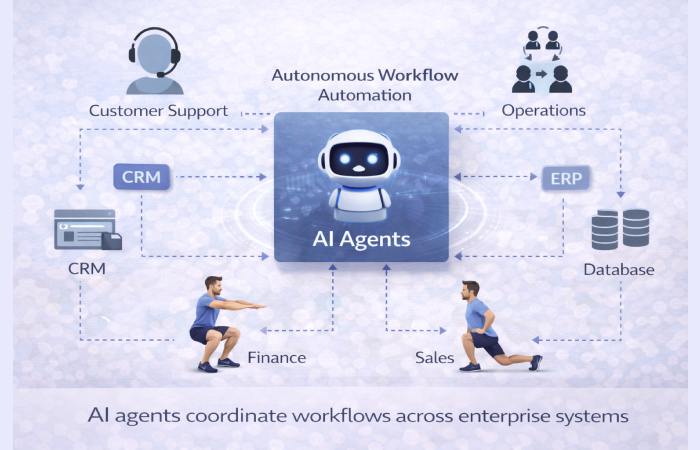
The most important AI trend in 2026 is the rise of agentic AI systems.
Unlike chatbots:
AI agents can
- plan tasks
- execute workflows
- call tools
- coordinate processes
- maintain memory across sessions
Enterprise applications are rapidly integrating task-specific agents into workflows.
Examples:
- coding agents
- research agents
- customer-support automation agents
- finance reconciliation agents
This shifts AI from reactive to proactive.
What Makes Agentic AI Different From Chatbots
| Feature | Chatbots | AI Agents |
| Respond to prompts | Yes | Yes |
| Execute tasks | Limited | Yes |
| Maintain memory | Limited | Yes |
| Call APIs | Rare | Common |
| Coordinate workflows | No | Yes |
This is the foundation of the “AI coworker” era.
Analysts expect nearly half of enterprise applications to embed AI agents into workflows by 2026.
Trend 2: Multimodal AI Becomes the Default Interface
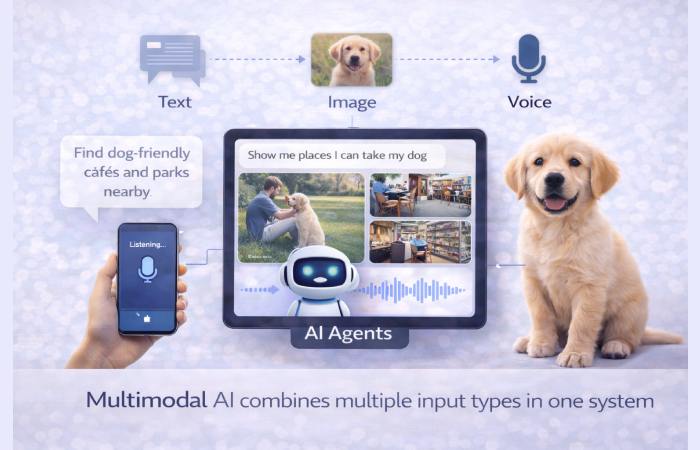
Multimodal AI systems can process:
- text
- images
- video
- speech
- structured data
in a single workflow.
Analysts predict 80% of enterprise software will include multimodal capabilities by 2030, with rapid adoption already underway.
Examples:
- text-to-video assistants
- voice-controlled productivity tools
- image-aware copilots
- multimodal analytics dashboards
Multimodal systems dramatically improve usability.
Trend 3: AI Copilots Everywhere
Copilots are expanding beyond coding tools.
By 2026 they exist inside:
- spreadsheets
- CRM systems
- marketing platforms
- design tools
- analytics dashboards
- document editors
Instead of standalone assistants:
AI copilots are becoming embedded operating layers.
Trend 4: Enterprise Workflow Automation With AI
AI is moving deeper into operations.
Instead of assisting individual users:
AI now coordinates entire workflows.
Examples:
- invoice processing pipelines
- compliance monitoring
- logistics optimization
- HR onboarding automation
Experts expect agent-driven workflow orchestration to define enterprise adoption patterns through 2026.
Trend 5: Domain-Specific AI Models Replace General Models
Large general models are powerful.
But specialized models are more efficient.
In 2026:
organizations are building models for
- legal reasoning
- healthcare imaging
- cybersecurity detection
- finance analytics
- engineering automation
Domain-specific AI improves accuracy and cost efficiency.
Trend 6: AI-Native Software Replaces Traditional SaaS
Traditional SaaS tools are evolving.
AI-native applications:
generate workflows automatically
adapt interfaces dynamically
predict user intent
optimize operations continuously
Some analysts warn AI disruption could reshape large parts of the SaaS ecosystem.
This transition is already underway.
Trend 7: Edge AI Reduces Cloud Dependence
Edge AI means:
processing happens on local devices instead of cloud servers.
Benefits include:
- faster response times
- better privacy protection
- lower infrastructure costs
- offline capability
Edge AI is especially important for:
mobile apps
industrial robotics
healthcare monitoring
automotive systems
Trend 8: AI Trust, Risk and Security Management (TRiSM)
As AI adoption grows:
risk management becomes essential.
TRiSM includes:
- governance policies
- bias detection
- compliance monitoring
- model transparency
- audit tracking
Gartner identifies AI trust frameworks as a major adoption priority.
Organizations deploying AI at scale must implement governance systems.
Trend 9: AI-Ready Data Infrastructure
AI performance depends on data quality.
2026 marks a shift toward:
AI-ready datasets
vector databases
semantic indexing pipelines
real-time analytics layers
Companies investing in structured data infrastructure outperform those deploying models alone.
Trend 10: AI Becomes a Core Developer Skill
Developers are shifting from:
writing logic
to
orchestrating intelligence
New roles emerging:
AI workflow engineer
prompt architect
agent designer
AI product integrator
Agent creation tools are becoming accessible even to non-developers.
Trend 11: Physical AI and Robotics Expand Into Real-World Tasks
Robotics powered by multimodal AI systems is entering:
warehouses
manufacturing
healthcare logistics
home automation
These systems combine:
vision
speech
planning
movement
Physical AI represents the next frontier after digital copilots.
Trend 12: AI Governance Becomes Mandatory Worldwide
Governments are introducing frameworks covering:
privacy
training data
copyright
model transparency
safety testing
Responsible AI deployment is now a competitive advantage.
Organizations that ignore governance risk legal exposure.
What Most People Misunderstand About AI Trends in 2026
Many assume:
AI replaces jobs immediately.
Research suggests:
AI transforms tasks gradually rather than eliminating entire roles instantly.
The real shift:
workers become AI-augmented professionals.
Industries Changing Fastest Because of AI in 2026
Top transformation sectors:
| Industry | Impact Level |
| Software development | Very high |
| Healthcare | High |
| Finance | High |
| Marketing | High |
| Logistics | Medium |
| Education | Medium |
Enterprise software integration is accelerating rapidly.
AI Trends Developers Should Watch Closely
Important areas:
agent frameworks
vector databases
RAG pipelines
multimodal inference
edge deployment stacks
These define next-generation architecture skills.
AI Trends Businesses Should Watch Closely
Key priorities:
workflow automation
data readiness
copilot integration
governance frameworks
ROI measurement systems
Enterprise adoption now depends on execution strategy.
AI Trends Students Should Prepare For
Recommended skills:
prompt engineering
Python automation
API orchestration
data literacy
AI ethics fundamentals
These skills future-proof careers.
AI Trends That Are Overhyped Right Now
Some technologies still face barriers:
fully autonomous enterprise agents
general AI reasoning systems
mass humanoid deployment
Integration cost and reliability remain challenges.
AI Trends Likely to Define the Next Five Years
Long-term trends include:
AI-native operating systems
real-time multimodal assistants
autonomous workflow platforms
agent marketplaces
AI-generated software stacks
These trends extend beyond 2026.
Who This Article Is For
Best suited for:
developers
tech students
startup founders
product managers
IT leaders
AI enthusiasts
Who This Article Is NOT For
Not intended as:
coding tutorial
investment advice
model-training guide
This is a strategy-level trend overview.
FAQs
What is the biggest AI trend in 2026?
Agentic AI systems coordinating workflows autonomously.
Is generative AI still important in 2026?
Yes, but it is evolving into multimodal and workflow-level intelligence.
Will AI replace developers?
No. It will change development workflows.
What industries benefit most from AI in 2026?
Software, finance, healthcare, and enterprise automation.
Is multimodal AI already mainstream?
Rapidly expanding across enterprise applications.
Conclusion
Artificial intelligence is entering a new phase in which tools are no longer limited to assisting users but are becoming integrated collaborators inside workflows, applications, and infrastructure. The most important AI trends 2026 include agentic systems, multimodal interfaces, AI-native software platforms, governance frameworks, and enterprise automation layers that are redefining how organizations build products and how individuals interact with technology.