
Understanding what central banks aim to achieve is key to grasping how modern economies work. If you’ve ever wondered “which best describes a central bank’s primary goals,” this article breaks it down in simple, human language.
Central banks are powerful institutions that influence everything from Inflation and unemployment to interest rates and financial stability. But what goals matter most? Let’s explore.
Table of Contents
What Is a Central Bank?
A central bank is a national or monetary authority that manages a country’s currency, money supply, and monetary policy. Central banks play a central role in shaping economic conditions and financial stability. (turn0search16)
Unlike regular banks, with which individuals hold accounts, central banks, commercial banks, and governments influence how money and credit flow through the economy.
The Basic Purpose of Central Banks
The overarching mission of a central bank is to promote economic stability and financial health. This goal unfolds across several key areas:
1. Maintain Price Stability
Keeping Inflation low and stable is the most fundamental central bank objective. Stable prices help households and businesses plan for the future with confidence. Many central banks aim for around 2% inflation as a healthy balance between growth and stability.
2. Support Economic Growth and Employment
Alongside price stability, many central banks strive to support a nation’s economic growth and maintain as much employment as possible. This means smoothing out the business cycle — not letting unemployment spike or growth collapse.
3. Ensure Financial System Stability
A stable financial system is less likely to experience bank failures or systemic crises. Central banks supervise commercial banks, act as lenders of last resort during crises, and help maintain confidence in the financial network.
4. Regulate Money Supply and Credit
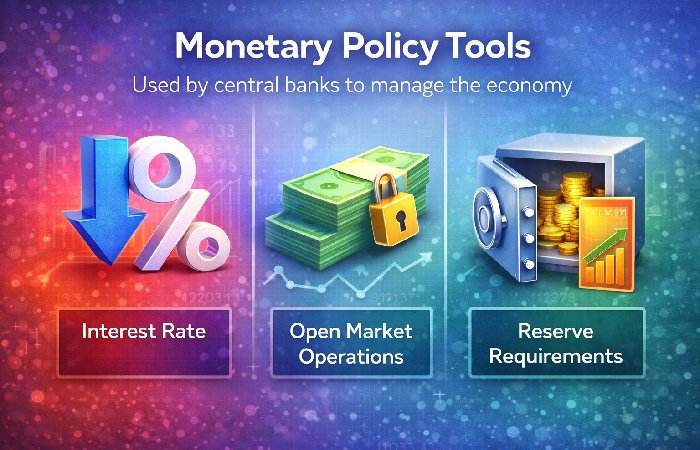
By controlling interest rates, open market operations, and reserve requirements, central banks manage the flow of money and credit through the economy, which affects Inflation, lending, and investment.
So What Best Describes a Central Bank’s Primary Goals?
While central banks have many responsibilities, most economists agree that the key primary goal is:
👉 Maintaining price stability and supporting sustainable economic growth with stable Inflation and employment.
This is often described as a dual mandate in many countries (like in the United States), where both stable prices and maximum employment are policy targets.
In simple terms:
✔ Control inflation
✔ Promote economic growth
✔ Stabilize the financial system
✔ Support employment
Why Price Stability Comes First
Price stability helps prevent rapid swings in the cost of goods and services. When Inflation is too high:
-
Purchasing power erodes
-
Savings lose value
-
Businesses struggle to plan ahead
Conversely, deflation (falling prices) can slow consumption and trap economies in downturns. So, stable prices serve as the foundation for almost all other economic objectives.
Differences Across Countries
Not all central banks have the same goals. For example:
-
The European Central Bank (ECB) prioritizes price stability but also supports broader economic objectives such as growth and employment.
-
Many developing economies also emphasize financial stability and credit control alongside price control.
Despite these differences, the underlying aim of keeping Inflation under control remains central to most mandates.
How Central Banks Achieve Their Goals
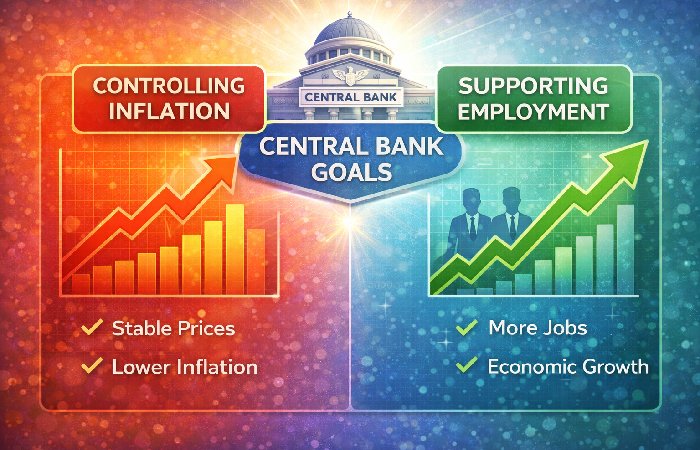
Inflation vs Employment Chart
-
Placement: “Examples: Central Bank Goals in Action” section
-
Idea: Simple infographic showing inflation control and employment support outcomes
-
Filename: inflation-employment-central-bank-chart.jpg
-
ALT text: “Infographic showing central bank goals of controlling inflation and supporting employment.”
Central banks use a set of tools to pursue their objectives:
🛠️ Monetary Policy
This is the biggest tool. By raising or lowering interest rates, central banks influence borrowing costs, spending, and Inflation. Lower rates typically stimulate growth; higher rates combat Inflation.
🔄 Open Market Operations
Buying and selling government bonds affects the money supply and short-term interest rates, helping steer economic conditions.
📊 Reserve Requirements
Setting required reserves for commercial banks affects how much they can lend, thereby influencing overall credit in the economy.
👤 Supervision and Regulation
Ensuring banks remain healthy helps prevent crises that could destabilize the entire financial system.
Examples: Central Bank Goals in Action
📉 Controlling Inflation
When Inflation rises above the target, central banks may raise interest rates to cool spending and reduce price pressures.
📈 Responding to Recession
During economic slowdowns, central banks may lower rates to encourage borrowing and investment.
🏦 Financial Crisis Support
If banks are failing or credit is tight, a central bank might act as a lender of last resort to stabilize the system.
Common Mistakes People Make About Central Bank Goals
❌ Thinking Central Banks Try to Maximize Growth
Growth is a goal, but not at the expense of runaway inflation or instability.
❌ Assuming Central Banks Control Government Spending
Monetary policy influences the economy, but fiscal policy (government spending/taxes) is separate.
❌ Believing Central Banks Guarantee Jobs
They aim to support employment, but they don’t directly create jobs — that’s more a matter of businesses and government policy.
Myths vs. Facts
| Myth | Fact |
|---|---|
| Central banks are profit-driven like commercial banks | They serve public objectives, not profit. |
| Their only job is printing money | Printing currency is minor; monetary policy is central. |
| They can fix unemployment instantly | They influence conditions but don’t directly control job creation. |
Practical Tips to Understand Central Bank Impact
✔ Watch inflation data releases — they often trigger market reactions.
✔ Follow interest rate meetings — these decisions shape borrowing costs.
✔ Read central bank statements for economic direction.
✔ Compare central bank goals across countries for deeper insights.
FAQs
Q: What is the primary goal of a central bank?
A: The primary goal is to maintain price stability and low Inflation, often alongside supporting economic growth and employment.
Q: Does a central bank control unemployment?
A: Central banks influence employment indirectly through monetary policy, but don’t directly create jobs.
Q: Why is price stability important?
A: Stable prices help consumers and businesses plan and make sustainable economic decisions.
Q: How does a central bank affect the money supply?
A: By adjusting interest rates and using open market operations to increase or decrease money in the economy.
Final Conclusion
To answer “Which best describes a central bank’s primary goals?” — central banks are chiefly tasked with maintaining price stability and keeping Inflation low, while also contributing to economic growth, employment support, and financial system stability through well-designed monetary policy tools. Their mandate influences key economic outcomes that matter to consumers, businesses, and markets worldwide.